
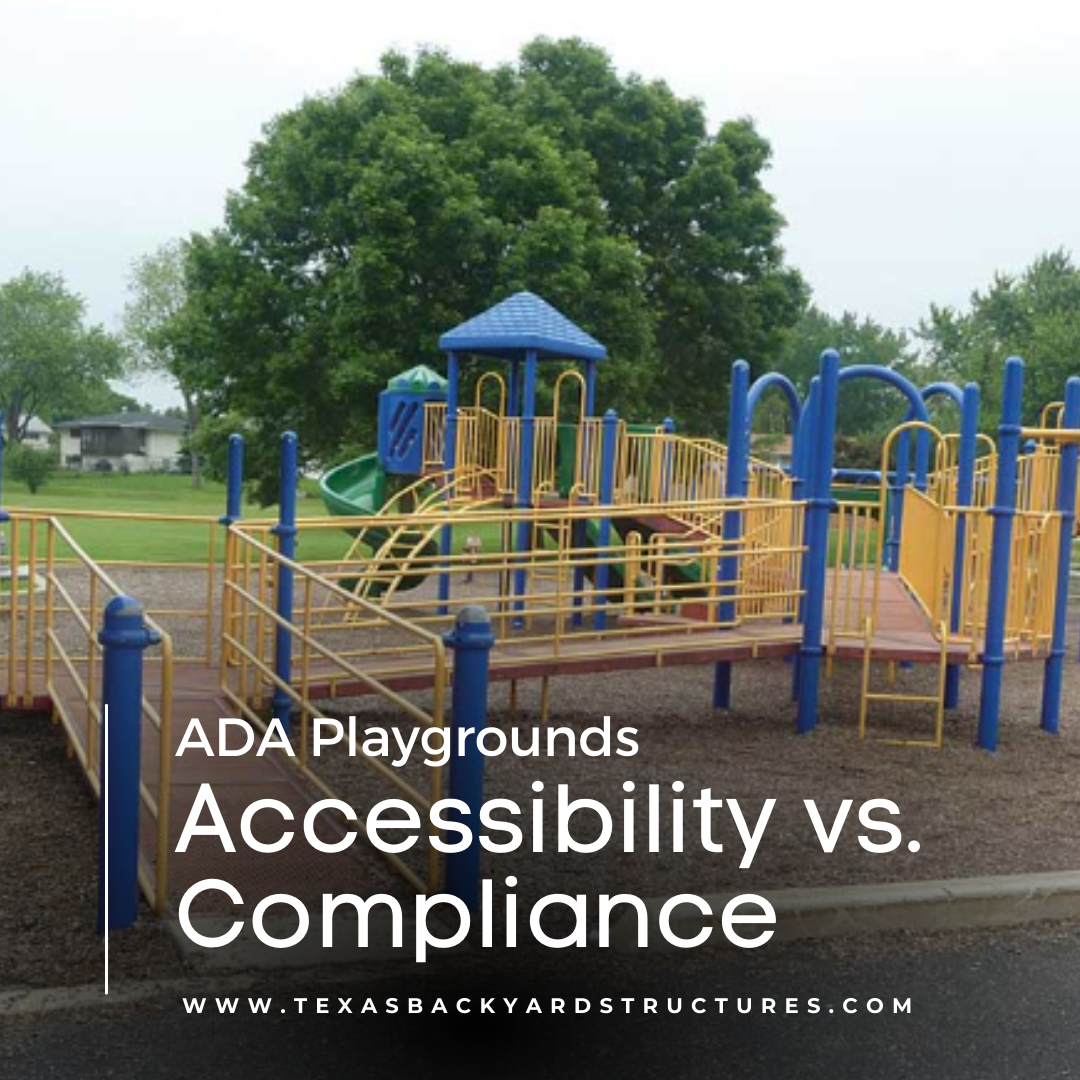
Playgrounds are essential spaces where children can play, grow, and develop. Ensuring that these spaces are inclusive and accessible to all is not just a moral imperative—it’s a legal requirement under the Americans with Disabilities Act (ADA). However, there is often confusion between ADA accessible and ADA compliant playgrounds. Understanding the distinction is crucial for designers, community planners, and parents to create play areas that truly serve every child.
This blog explores the key differences between ADA accessible and ADA compliant playgrounds, the requirements for compliance, and how to create inclusive play environments that meet and exceed legal standards.
What is the ADA?
The Americans with Disabilities Act (ADA) is a landmark civil rights law enacted in 1990. It prohibits discrimination based on disability in various areas, including employment, transportation, and public spaces. Title II and Title III of the ADA specifically address the design and accessibility of public facilities, including playgrounds.
ADA standards ensure that individuals with disabilities can access and use facilities safely and independently. When applied to playgrounds, these standards outline guidelines for equipment, pathways, and surfaces to promote inclusion for children of all abilities.
What Does ADA Accessible Mean?
An ADA accessible playground provides features that make it possible for children with disabilities to access certain parts of the play area. However, accessibility does not necessarily mean full compliance with ADA standards. Accessibility typically focuses on:
- Pathways: Providing a clear route to and within the playground, which may include ramps or hard surfaces for mobility devices.
- Entry Points: Ensuring children can get onto some play equipment, such as a swing or a slide.
- Partial Adaptations: Including some inclusive features, like sensory panels or ground-level play structures.
An ADA accessible playground may fall short of providing equal play opportunities across all areas of the playground, limiting the experiences available to children with disabilities.
What Does ADA Compliant Mean?
 An ADA compliant playground fully adheres to the guidelines established by the ADA Standards for Accessible Design. Compliance goes beyond mere accessibility to ensure the entire playground provides equitable use for children with varying abilities. Key features of ADA compliant playgrounds include:
- Accessible Routes:
- A continuous, unobstructed path within the play area.
- Surfacing that meets ADA standards for firmness, stability, and slip resistance (e.g., rubber mats, poured-in-place rubber, or engineered wood fiber).
- Inclusive Play Equipment:
- A variety of ground-level and elevated play components accessible to children with disabilities.
- Adaptive swings, wheelchair-accessible merry-go-rounds, and sensory play panels.
- Proportional Requirements:
- Play areas must include a certain number of accessible components based on the size of the playground. For instance:
- If a playground has 20 elevated components, at least 25% must be accessible via ramps or transfer points.
- Play areas must include a certain number of accessible components based on the size of the playground. For instance:
- Spaces for Caregivers:
- Consideration for adults with disabilities, such as accessible seating and pathways.
- Equity in Play:
- Features designed to ensure children with disabilities can engage in the same types of play (physical, social, sensory, and imaginative) as their peers.
Key Differences Between ADA Accessible and ADA Compliant Playgrounds
| Feature | ADA Accessible | ADA Compliant |
|---|---|---|
| Pathways | Provides some routes for accessibility | Meets ADA standards for all pathways |
| Play Equipment | Includes some accessible components | Meets proportional requirements |
| Surfacing | May not fully meet ADA standards | Complies with ADA surfacing standards |
| Inclusive Play | Limited opportunities for full equity | Ensures equal play opportunities |
| Legal Compliance | Partially aligns with ADA guidelines | Fully adheres to ADA requirements |
Why ADA Compliance Matters
Creating ADA compliant playgrounds ensures that children of all abilities can:
- Play Safely: Compliant surfacing minimizes the risk of injury during falls.
- Engage Equitably: Every child can enjoy play structures, fostering inclusion and social interaction.
- Develop Skills: Physical, cognitive, and social skills are developed through diverse play opportunities.
- Feel Valued: Fully inclusive playgrounds send a message of belonging and equality.
Compliance also protects organizations, schools, and municipalities from potential legal challenges and penalties for failing to meet ADA requirements.
Steps to Create an ADA Compliant Playground
 To achieve full compliance, consider the following steps:
1. Understand ADA Standards
Familiarize yourself with ADA guidelines for playgrounds, including:
- Accessible routes
- Ground-level and elevated play components
- Surfacing requirements
- Transfer systems and ramps
2. Choose Inclusive Equipment
Incorporate a mix of accessible and inclusive play elements, such as:
- Sensory panels for tactile and auditory stimulation
- Wheelchair-accessible swings and ramps
- Adaptive play components like seated spinners
3. Invest in Compliant Surfacing
Select ADA-approved materials, such as:
- Poured-in-place rubber
- Engineered wood fiber
- Rubber tiles or mats
These materials provide stability, firmness, and shock absorption, making the playground safe and accessible for mobility devices.
4. Ensure Proper Proportions
Follow the ADA’s proportional guidelines for accessible play components. For example:
- A playground with 10 elevated structures must provide access to at least 3 through ramps or transfer stations.
- Include a balanced mix of ground-level components to offer play opportunities for all.
5. Engage Experts
Work with certified playground designers or ADA consultants to ensure your design meets all standards.
6. Test and Maintain
Regularly inspect and maintain playground equipment and surfacing to ensure ongoing compliance and safety.
Benefits of ADA Compliant Playgrounds
 ADA compliant playgrounds provide numerous benefits for children, caregivers, and communities:
1. Fosters Inclusivity
Children with and without disabilities can play together, building empathy, understanding, and friendships.
2. Encourages Physical Activity
Accessible equipment ensures all children can engage in active play, promoting physical health and well-being.
3. Enhances Cognitive Development
Interactive and sensory-rich components stimulate problem-solving, creativity, and learning.
4. Strengthens Communities
Inclusive playgrounds become gathering spaces where everyone feels welcome and valued.
Final Thought on ADA playgrounds
The distinction between ADA accessible and ADA compliant playgrounds highlights the importance of going beyond minimal accessibility to create truly inclusive spaces. By prioritizing ADA compliance, communities can ensure that every child, regardless of ability, has equal opportunities to play, grow, and thrive.
Investing in an ADA compliant playground not only meets legal requirements but also fosters a sense of belonging, safety, and joy for children and families. When designing or upgrading playgrounds, let’s aim for compliance that transforms accessibility into meaningful inclusion.
